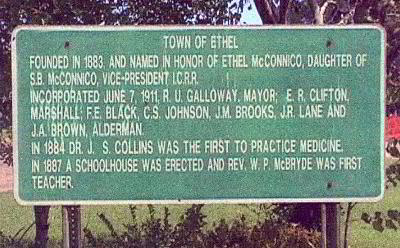
 The following text was transcribed from the audio portion of a television program named 'Eye On Kosciusko', aired on WMAB TV of Kosciusko, Miss. sometime in the late nineteen-ninety's. Please keep in mind, as you read, that this is a transcription of a verbal interview. Often it will not follow the conventions of written context. In the interest of readability, certain liberties have been occasionally taken with the original, verbal utterances. Though these changes have been infrequent, they were necessary to help maintain the integrity of the transcript.
Interview with Beatrice Bailey, Ethel Historian

Interviewer: Willa Sanders

WS: (To the camera) Welcome to Eye On Kosciusko. Ethel, one of the
    communities in our county, is named after a lady. It would be
    interesting to find out the history about that, so I've invited Beatrice
    Bailey, a resident of Ethel, to give us a little background about Ethel,
    Mississippi.

    Welcome, Ms. Beatrice.

BB: Thank you.

WS: We'd like to know, if you know, why or how did Ethel get it's name?

BB: The town of Ethel was established in 1881. The railroad came through in
    1882. They built the first depot in 1883 and laid out the town lots.
    The town was named for the daughter of the vice president of the
    Illinois Central Railroad. He wanted his daughter to have a town named
    for her, so they let him name the town Ethel, in honor of her. Her name
    was Ethel McConnico.

WS: Well, when was the town incorporated?

BB: In 1911, and it was really a booming town before it was incorporated.

WS: Give us a little history about how it developed. What was the first
    store?

BB: The first store was built by one of the people who bought the land.
    The land was bought from a lady here in Attala county, named Mrs. Davis.
    She was a widow. They bought the land, 800 acres, for fifty cents an
    acre. That was in 1880. Two men bought it. One man took his half and
    built a steam mill, a store, and a residence. History does not tell us
    what the other man did, other than that they laid out the lots. They
    sold the lots for the fifty cents an acre to the ones who could pay.
    They wanted people to come there so bad that, if someone wanted to come
    but didn't have the money to buy, they gave them the lots.

WS: Did Ethel have a doctor?

BB: We had Dr. J.S. Collins. He was first doctor, in 1884. He was followed
    by Dr. J.T. Hale, Dr. W.R. Pope, Dr. W.S. Clair, and Dr. W.W. McBride.
    Dr. McBride practiced until the late fifties and early sixties. When he
    retired, he was much over 90 years old.

WS: Well, tell us about the school now. When was the school built?

BB: The first school was built in 1887. It was built on a lot behind the
    stores that runs parallel back of the stores and it was on a lot that
    is now used for the building site for the Masonic Lodge. It was just a
    small building and had just one teacher. The people were so impressed
    with the school that later they wanted to build more to the school.

WS: Isn't there some sort of a rock building or something that is sort of
    historic up there on the school site now?

BB: Sometime during the early thirties, the students of the 'Ag' Dept.
    (Agriculture Dept.) gathered rocks from the farm of Mr. Swindle, who
    was the 'Ag' teacher. They brought the rocks to school and the rock
    building was built by the students. It housed the Home Economics Dept.
    and the Agriculture Dept.

WS: That's interesting. Where is the town exactly located? Give us a
    little description.

BB: Ethel is nine miles east of Kosciusko on highway 12. It was situated
    on the north side of the Illinois Central Railroad and was bound on
    the other side by the Yockanookany River. It had a street that ran to
    the river on the north and the south side.

WS: I know that, at least in your booming days, there were several lumber
    mills. Can you name those for us?

BB: We've had many, many lumber mills at different times. The Moller (and)
    Vanderboom Lumber Co., out of Quincy, Illinois, came in 1916 and
    established a large lumber mill. At the time, there were no electric
    lights in the city. They brought a dynamo with them from Illinois and
    put lights in their mill and in their office. The office that they
    built at that time still stands and is in use today. Following that...
    this was a large lumber company; they had dry kilns and they had
    seventeen acres of land that they stacked lumber, at least two stories
    high, out in the yard. They also had a dipping vat that they dipped
    the green lumber in to keep it from staining when it dried out in the
    weather. That mill is still in operation today and is owned by a man
    out of Kosciusko.

WS: Do you know anything about the other mills?

BB: The other mills were the Bowman Lumber Co., Jay's Lumber Co., Ethel
    Planing Mill, Abrams Lumber Co. All of these were in the twenties and
    thirties. Some of them left when the depression came.

WS: Mayor Jerry Hindley had contact or connections with one of them.

BB: The Bowman Lumber Co. went out of business during the depression, in
    1930, and it sat idle for three years. Then it was bought by a Mr.
    Barge, who operated it as the Ethel Lumber Co. He did that until 1944.
    He let his planer mill right-hand-man, Jimmy Hindley, have it. Jimmy
    operated it then until he retired, and at that time turned it over to
    his son, Jerry Hindley. The mill is no longer in operation, but Jerry
    has extensive timber operations in both lumber and hauling timber.

WS: I think you worked for Moller/Vanderboom, didn't you, at one time?

BB: Moller/Vanderboom is special to me because as a graduate of Holmes
    Junior College, that was my first full-time job. I was just twenty
    when I started work there, and very shy, but went there with all those
    men, about a hundred employees at that time. That was a special time
    in my life.

WS: That's where you learned to drive, wasn't it?

BB: I didn't know how to drive. Back in those days, every family didn't
    have a car and the men of the house drove the cars. The girls didn't
    know how to drive. So when I went to work for Moller/Vanderboom, I did
    not know how to drive. I had to learn on whatever vehicle they had.
    The main vehicle they had, for the president and vice-president to use
    when they came, was an old Huffmobile, which is an old, old make of
    car. It was like a limosine. They had a pick-up, which was kind of
    beat up, and they also had lumber trucks. I could drive any of them.
    I sometimes drove the pick up, a few times drove the Huffmobile, but
    most of the time I chose one of the lumber trucks, with the trailer
    detached. It was not easy learning to drive because this was winter
    time and there were so many trucks and wagons pulling lumber in there
    that the roads were bad, bad. Sometimes you had to drive on lumber
    laid down side-by-side to make a runway for you to drive on. You had
    to stay on that, or else you would get stuck.

WS: How much did a drivers license cost back in those days?

BB: A drivers license, in those days, was twenty-five cents. You went
    over to the depot, the Illinois Central Railroad depot, and the agent
    over there let you have your drivers license for twenty-five cents.
    You did not take a test. You were just given your drivers license, on
    just faith.

WS: I know that the railroad played a big part in the development of Ethel.
    You've spoken of it several times. Tell us a little bit about that, or
    if you had experiences with it.

BB: The railroad, when it first came through, had a train going east and
    west in the morning and east and west in the afternoon. There were no
    eighteen-wheelers at that time, and it was used for all the shipping.
    We had passenger trains with a few freight cars, but then they had
    freight trains as well, just regular freight trains.

    Our family had friends up east of Ethel, so we used to ride the train
    up in the morning, spend the day, have lunch and ice cream and all the
    good things that the lady prepared, and then ride home in the afternoon
    on the train.

WS: I think you related to me also: Didn't your mother also go on shopping
    trips and use the train?

BB: My mother used to go to Kosciusko and do the shopping for the winter.
    Most of the time, in the summer, she made our clothes. But, in the
    winter, she had to buy some things that she could not make. She would
    take a day, go down on the train, come to a major department store here
    in Kosciusko, and make her purchases. They would pack it up in a great
    big shipping carton, put it on the train, and it would come back on the
    train with her in the afternoon. Our daddy would meet the train, pick
    it up, and bring it home. It was just like Christmas when she opened
    that box. We'd all dive in. We'd look to see what she'd brought for us.

WS: Name some other businesses in Ethel, when it was at it's highest
    economic activity.

BB: Ethel had many, many stores, hardware stores and mercantile stores.
    Some of the younger people might not know what a mercantile store was.
    A mercantile store had everything you could want, or you thought you
    would want. You'd go in there and you'd look 'til you found what you
    wanted. We had dry goods stores that had ready-to-wear and fabrics
    and things like that. At one time, we had a milliner's shop. One of our
    doctor's wives had a milliner's shop.

WS: Milliner's shop? Tell us what that is.

BB: That is a hat shop. She was a real dressy lady and had come from away
    from Ethel and she was really fixing us up with the hats.

    Ethel, at one time, had it's own telephone service that was operated
    by a family, from their home. It was one of those old crank-type phones.
    You'd call the operator, tell her who you wanted, and she would connect
    you with them.

    At the very height of Ethel, we had two hardware stores, four just
    regular department stores, as we would call them today. They were just
    general stores. We had two cafes and two hotels, that is two, two-floor
    hotels, and many boarding houses.

WS: What about service stations?

BB: We had five service stations, and I mean full-service, service stations.
    You could get a flat fixed or they would pump your gas. It wasn't like
    the self-service that we have today. We had a major Chevrolet dealer and
    they had four mechanics, all the time. They had a full-service, service
    station and a body shop with this Chevrolet agency that was there, at
    that time.

WS: Well, that's quite impressive. What about bus service?

BB: The bus service was the Trailways Bus. It had a bus running east and
    west both morning and afternoon. Going north, it didn't seem as crowded
    as it did coming back. I remember, as a teenager going to college, all
    the teenagers went by bus because their parents didn't furnish them a
    car, like we do today. Every child has his car. But we didn't have our
    cars and we had to ride the bus. We had many, many students from up
    around Ripley and Tupelo and places like that that got on the bus up
    there and came to Ethel. By the time it got to Ethel, the bus was
    packed. Some bus drivers would call for a back-up, but some didn't.
    Then we had to stand and hold to the rail where the luggage was placed
    in order not to fall, as we were standing. But we probably couldn't
    have fallen far because it was so packed with people standing, riding
    the bus.

WS: So, you rode all the way to Holmes Community College?

BB: We rode all the way to Holmes Community College the first year. The
    second year, they were reworking Highway 51, from Durant to Canton, and
    we had to go around by way of Lexington. When we got to Lexington, the
    bus couldn't go on the highway that ran from Lexington to Goodman, so
    we had a friend in Goodman who met us there and carried us on to
    college. He would take as many people as he could to the college.

WS: Didn't you go on your honeymoon on the bus?

BB: Yes, I did. In 1939, when Elmer Ray and I married, we went by bus to
    Jackson. The bus station was not too far from the Heidelberg Hotel. We
    had reservations there, for our honeymoon.

WS: Do you recall any dates about the infrastructure of your community,
    like paved streets and things like that?

BB: The paved streets was along about 1953. Before that time, it was pretty
    bad, especially in the winter time, with all the wagons and trucks
    bringing lumber in to the different lumber companies.

    The electric lights...when Mississippi Power came into the area, they
    came into Ethel. I'm not sure of the date of that, but when they came
    in they put vapor lights all over the city.

WS: What about water?

BB: Water came in about 1953. They built two wells, with an elevated water
    tank. Then it was later, in 1956 or 7, that they built the lagoon that
    takes care of the waste and put in the sewer system.

WS: Do you recall a time when your community really pulled together?

BB: Yes. In 1928, the Ethel Lumber Company had a boiler to explode that
    killed five men. The remnants of the boiler went sailing across the
    street into a store, a mercantile store, and just cleaned it out,
    just took it apart. Ethel pulled together and tried, as best we could,
    to help with these bereaved families, who had lost five men. In a town
    of that size, to lose five people at one time, was very distressful.

WS: What is the population, now, of Ethel, would you say?

BB: The population, now, is about six hundred.

WS: And, at it's highest, was it, say, close to a thousand?

BB: A thousand or more.

WS: Who's your mayor?

BB: Our mayor now is Jerry Hindley, and we are a city that's governed by a
    mayor and board of aldermen. We have five aldermen. It's always been a
    mayor and board of aldermen.

WS; And, what about churches?

BB: We have two full-time churches now. Ethel Methodist and Ethel Baptist,
    each of which have celebrated their one-hundredth anniversary. The
    Ethel Methodist Church is not as many as the Ethel Baptist, but they
    are very active in the community, as well as in the religious circles.

    Ethel Baptist recently completed a new fellowship hall, just before
    the time for their one-hundredth anniversary.

WS: Which one's the oldest?

BB: The Ethel Methodist Church is the oldest. The Ethel Baptist is next
    and then the Presbyterians were there, at one time, and the Church of
    God, but they're no longer there.

WS: Well, this has been very interesting. I appreciate, so much, you
    coming and giving us this history about the town of Ethel. I know that
    a lot of our viewers probably have wondered why it was named Ethel.
    It's real nice to be caught up on this history. At one time, it
    apparently was a very booming town.

BB: It was a booming town, and you have quite a few prominent people in
    Kosciusko who came from Ethel. Since we don't want to leave someone
    out, we won't mention any names, but two of your bank presidents in
    Kosciusko are from Ethel, and there are many others. Two of your
    mayors of Kosciusko were originally from Ethel.

WS: A lot of good people. All over Attala County, we have a lot of good
    people.

    We really appreciate you digging up this information for us and
    catching us up on the history of Ethel.

    (To the Camera) And we really appreciate the fact that you're tuned
    in. For 'Eye on Kosciusko', I'm Willa Sanders...
Page 1 of 1 |

